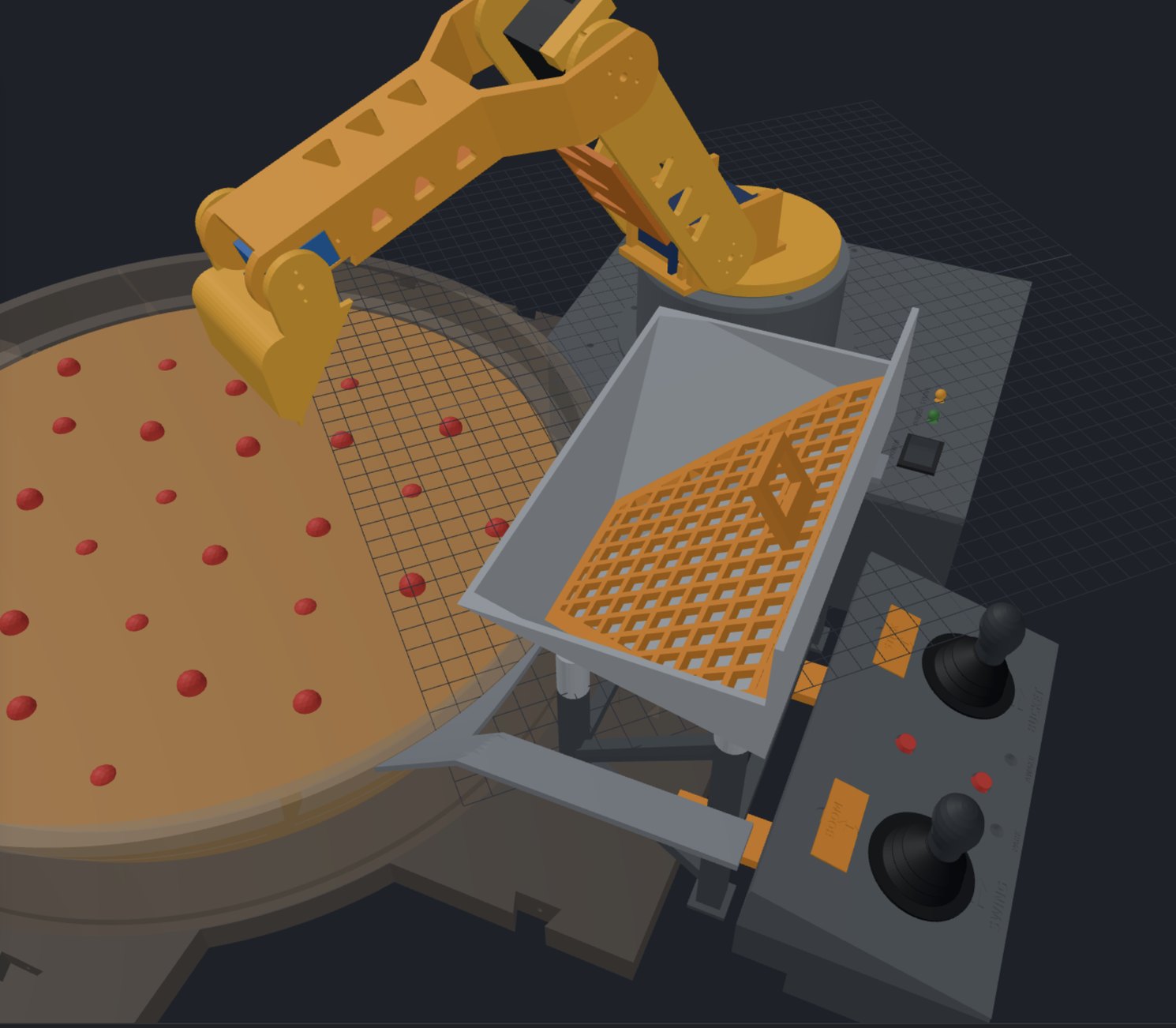
Dig Pod 1 has servos, a stepper and an ESP32. Dig Pod 2 has none of that. It's a miniature of the sand diggers you see in playgrounds: you pull the levers, and the arm digs. It drops into the same corner of the game board, so a game can mix electric pods and hand-worked ones.
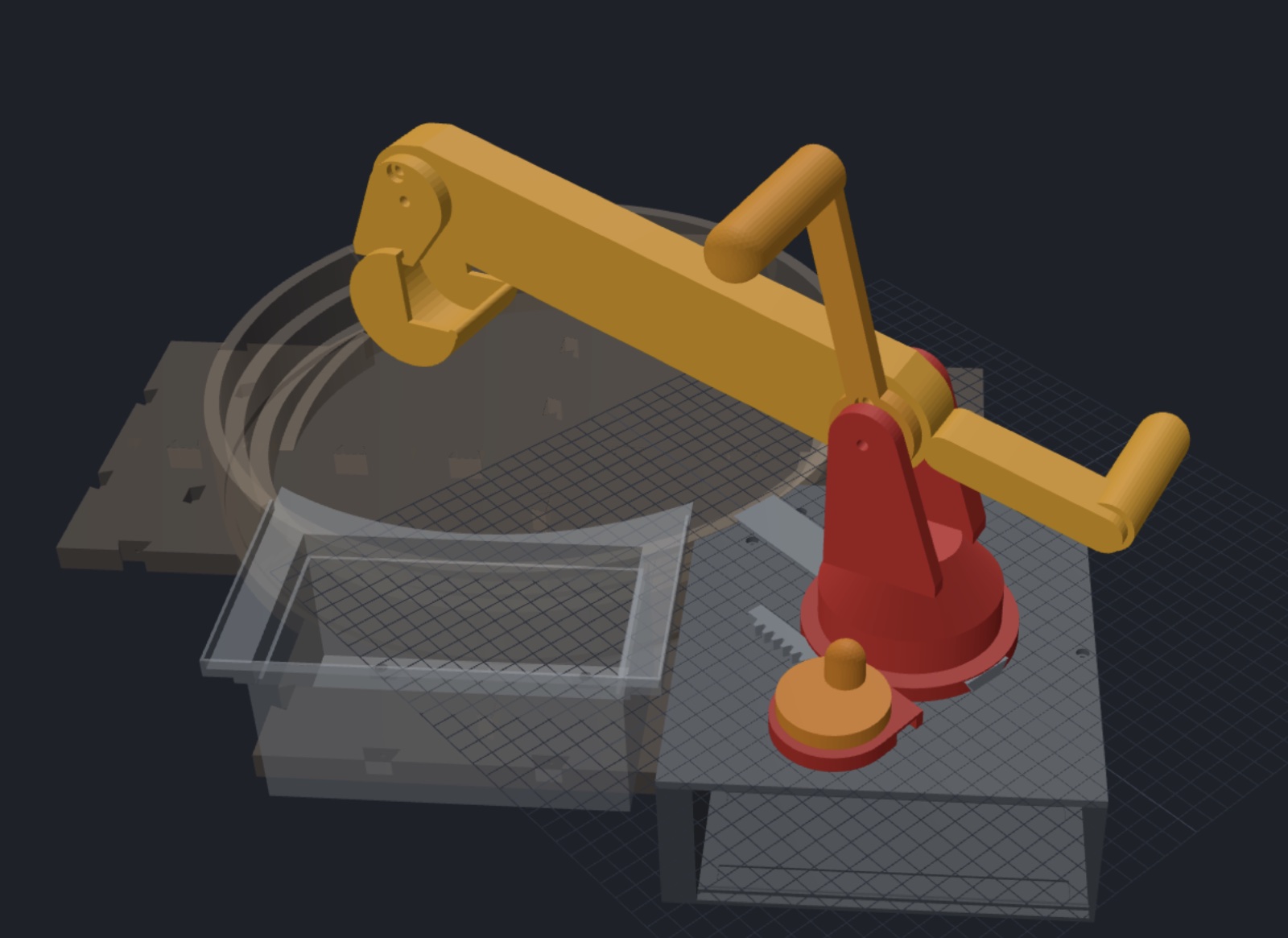
How the playground digger works
The playground version has three motions and no elbow:
- Swing: the whole machine turns on its post. You push the levers sideways.
- Boom: the rear lever is the boom's own tail. Pull it back and the arm lifts.
- Bucket: the front lever turns on the same axle and pushes a long rod to the bucket. The two levers and the rod make a parallelogram, so the bucket keeps whatever angle the lever has, whatever the boom does.
The first model did just that:
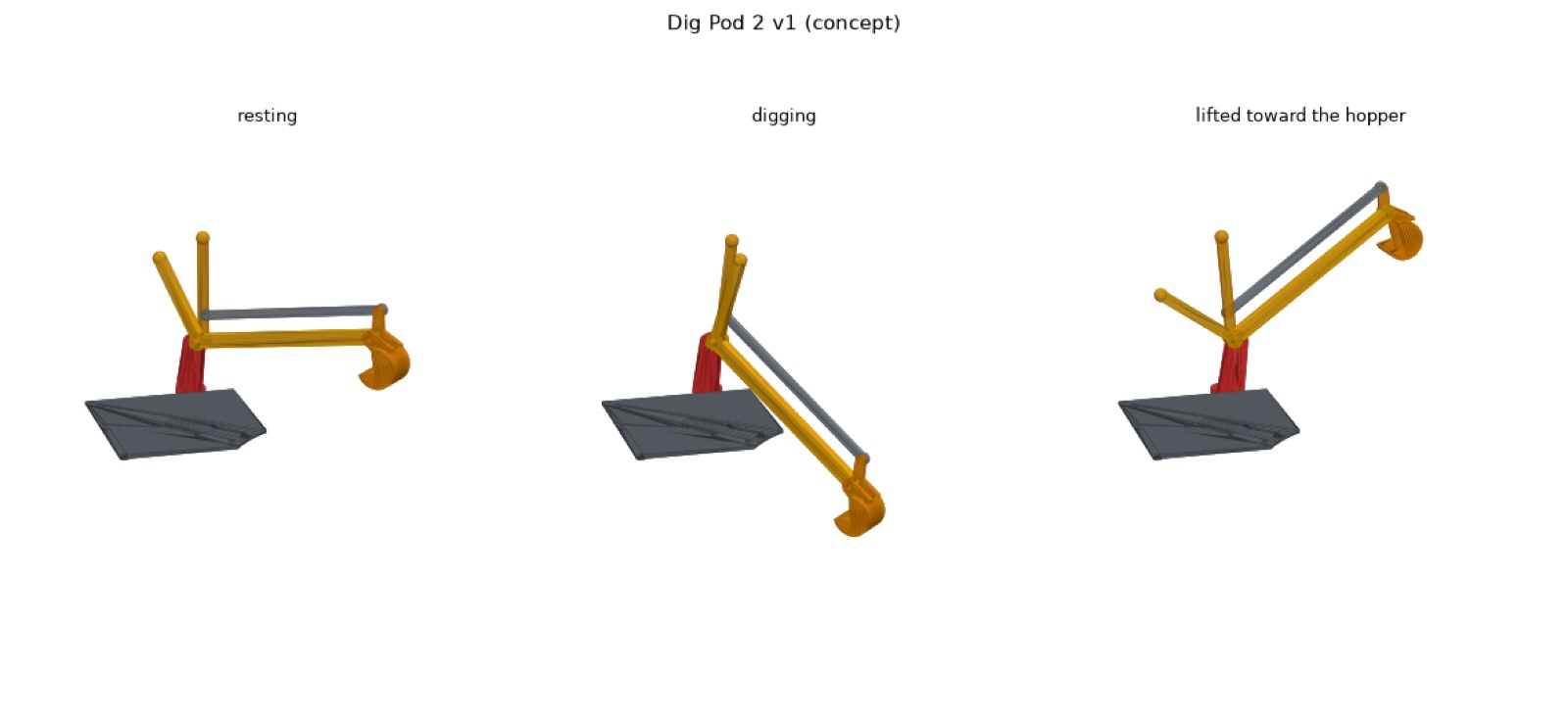
Made for kindergarteners
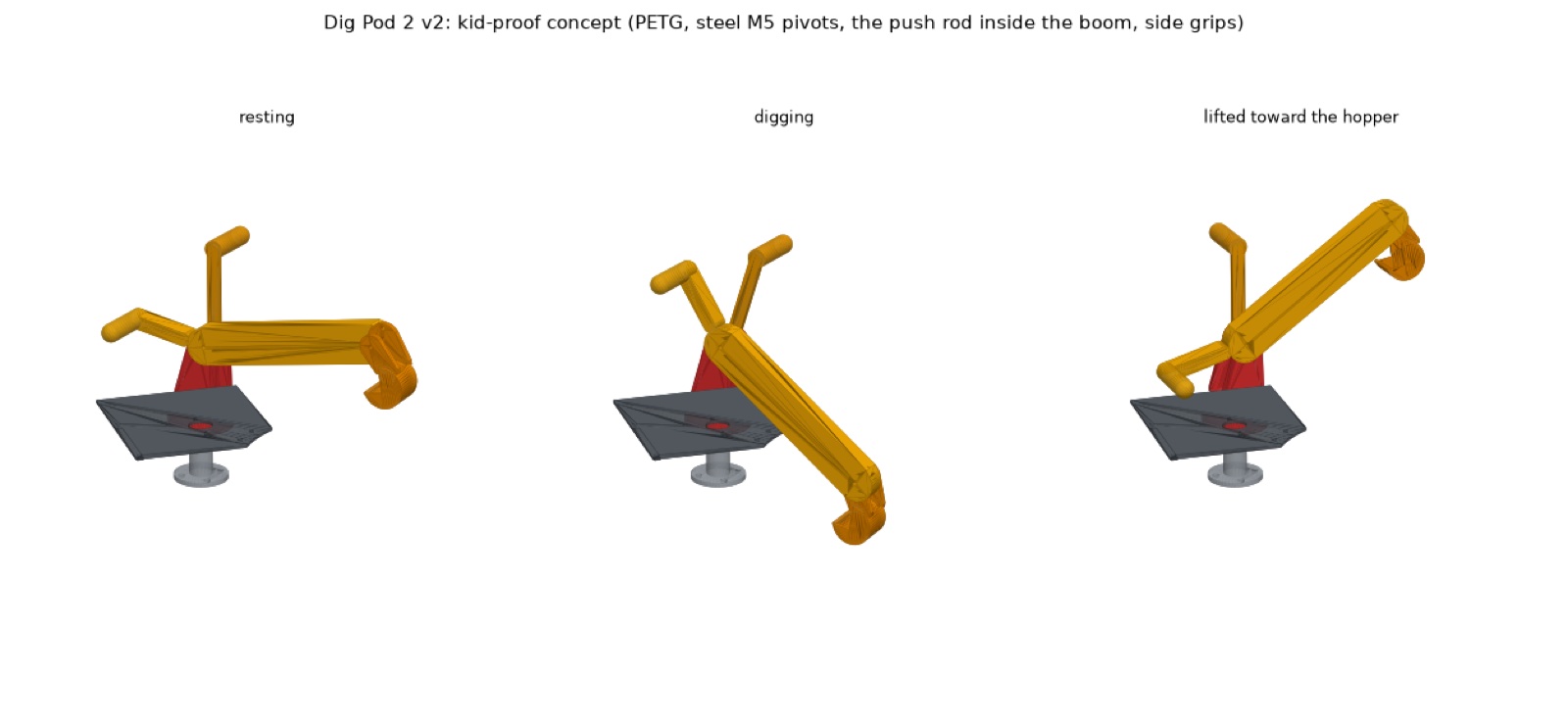
Then I thought about who would use it: five-year-olds. They hang on handles, push past stops, and put their fingers in every gap. The first model would have snapped at its printed axles and pinched fingers between the rod and the boom. So version 2 changed a lot:
| Problem | Fix |
|---|---|
| A child hanging on a 30 cm arm (about 30 N·m at the swivel) | steel M5 bolts at every pivot, a thick 30 mm post bolted through the platform's floor, PETG instead of PLA |
| The rod and the boom closing like scissors | the rod runs inside a hollow box boom, which also stops it bending |
| Slots where the levers reach the rod | discs on the levers and the bucket cover them at every angle |
| Fingers at the swing's stops | the stops are hidden under the turret's skirt, 1 mm above the deck |
| Two handles closing on each other | each lever has a grip sticking out to its own side (my idea), so hands stay apart |
More reach: a sled and a hand wheel
One straight boom only digs a band about 110 mm wide, wherever you put it. On a real playground digger you'd move your whole body. So in version 3 the whole turret rides on a sled along a rail toward the pit, moved by a hand wheel turning a gear on a toothed rack. The wheel is a solid disc with a knob, with no spokes to catch fingers. Then I made the bucket bigger and let it open wider.
| Version | Bucket reaches (mm out from the swing axis) |
|---|---|
| v1, as first drawn | 112–226 |
| v3, on the sled | 119–246 |
| v3, bigger bucket opening wider | 131–277 (past the pit's middle at 260) |
Every version is checked in the model through every combination of travel, swing, boom and bucket. Nothing can hit anything else, and the bucket always lifts well clear of the hopper. In Bench's 3D view I can now grab the levers, the wheel or the sled with the mouse and work it like the real thing.
What I learned
- A playground design is a good starting point. It's already been worked out for kids, and it fits in two levers.
- Design for who'll use it. The first version worked, but a five-year-old would have broken it or pinched a finger in a day.
- Pinch points come from gaps that close. Keep a moving gap either too small for a finger (under 4 mm) or too big to trap one (over 25 mm), or cover it.
- One fixed boom has a fixed reach. Moving the whole machine is a simpler fix than adding joints.
- Being able to drag the parts around showed me how it feels long before printing anything.
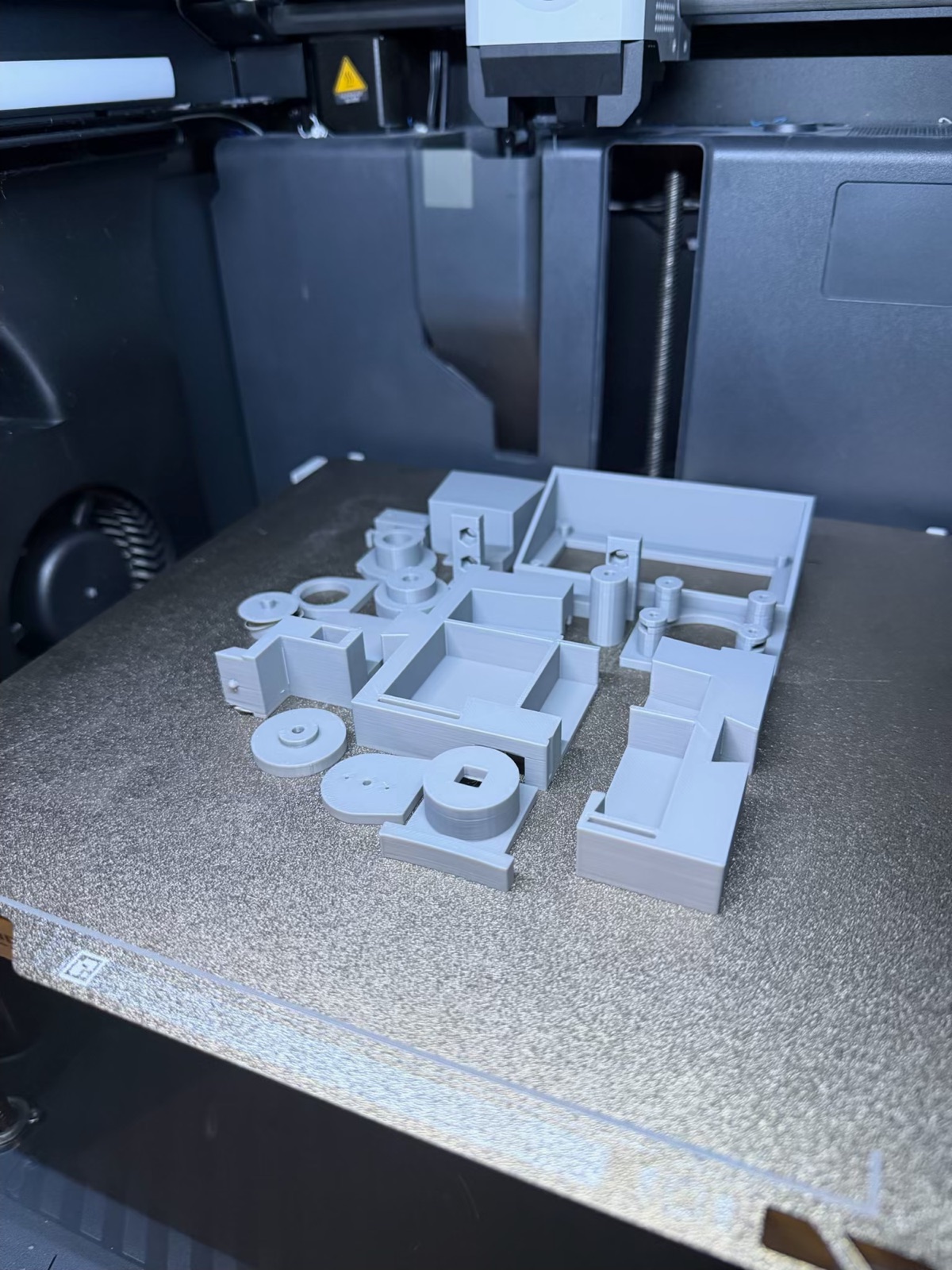
Still to do: rubber bellows over the rail, covers over the bolts, a lock to hold the platform in the board, and splitting the long boom so it fits on the print bed.
Comments (0)