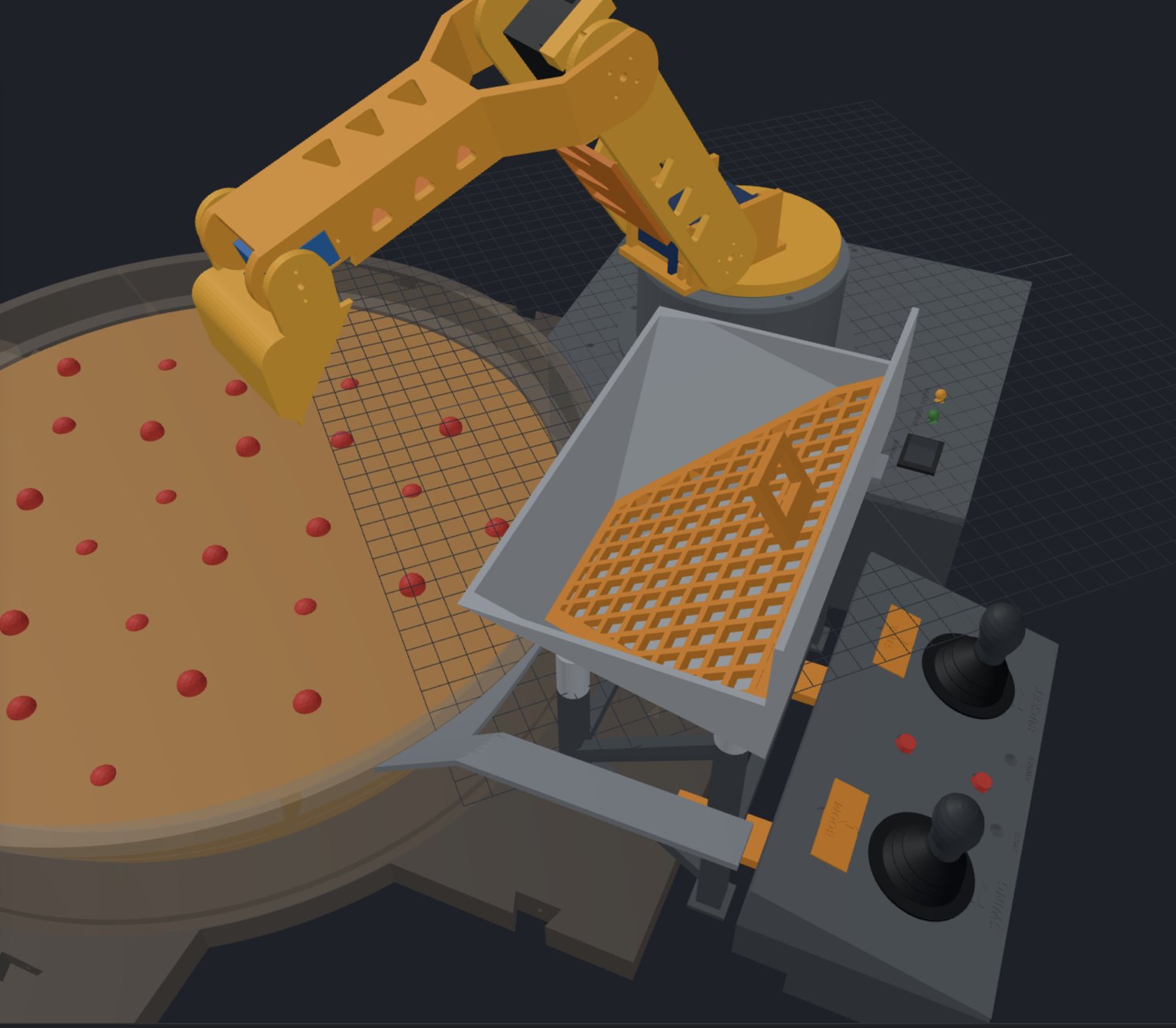
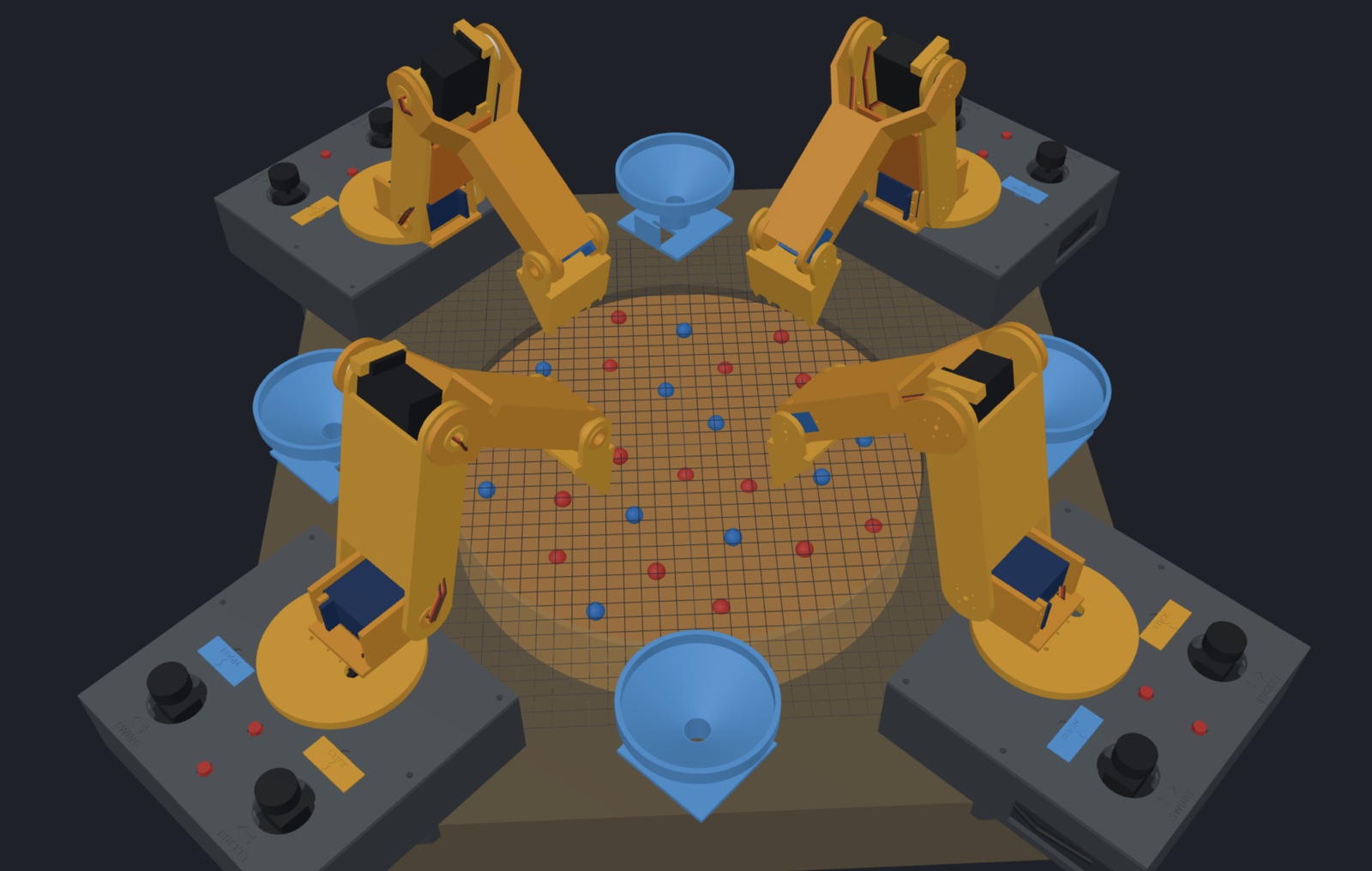
Each crew's hopper is now designed: a bin in front of the console with a grate inside. The bucket dumps lentils and gems together. The lentils fall through the grate and slide back into the pit, and the gems stay on top. Nothing is printed yet.
The sketch
The old hopper was a concept: a bin on legs feeding a conveyor into a counting box. Every bucket of lentils would have ended up in that box, and then on the table. I wanted less mess, so I drew what I had in mind on a sticky note: a big bin with a grate inside, holes larger than a lentil, and a chute under it back into the pit.
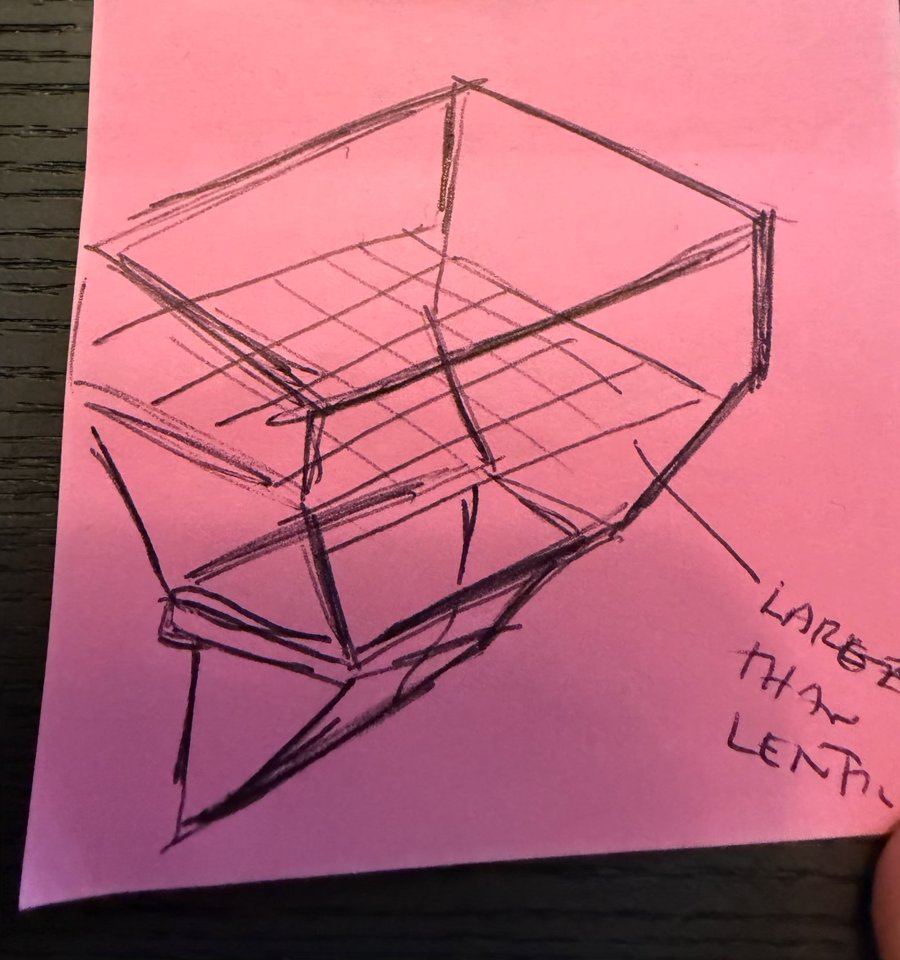
Real mines do the same thing with a grizzly: a grate over a hopper, where the fine material falls through and the big pieces stay on top.
One question at a time
| Question | My answer |
|---|---|
| How do the gems come out to be counted? | The grate lifts out with the gems on it. A sloped grate into a drawer can come later. |
| How big is the bin? | About as wide as the console: 165 mm long. The bucket is 52 mm wide, so there's room for a sloppy dump. |
| Where does it sit? | Along the front of my console, the same length, and entirely outside the pit |
| What about the gaps round it? | Sloped walls that send spills back toward the pit |
Fitting it in took a layout. The pit, the two platforms and the console leave a gap only about 60 mm deep between the crater's rim and the console. So the console moves 45 mm further onto the table, on longer feet to its sockets in the board, and the bin is 95 mm deep.
How it works
- The grate has 7.5 mm square holes. Lentils are 4–6 mm and go through; the gems are 10–12 mm and don't.
- The floor under the grate slopes 32° toward the pit and narrows to a 40 mm outlet. The grate slopes with it, so the gems gather at its low end.
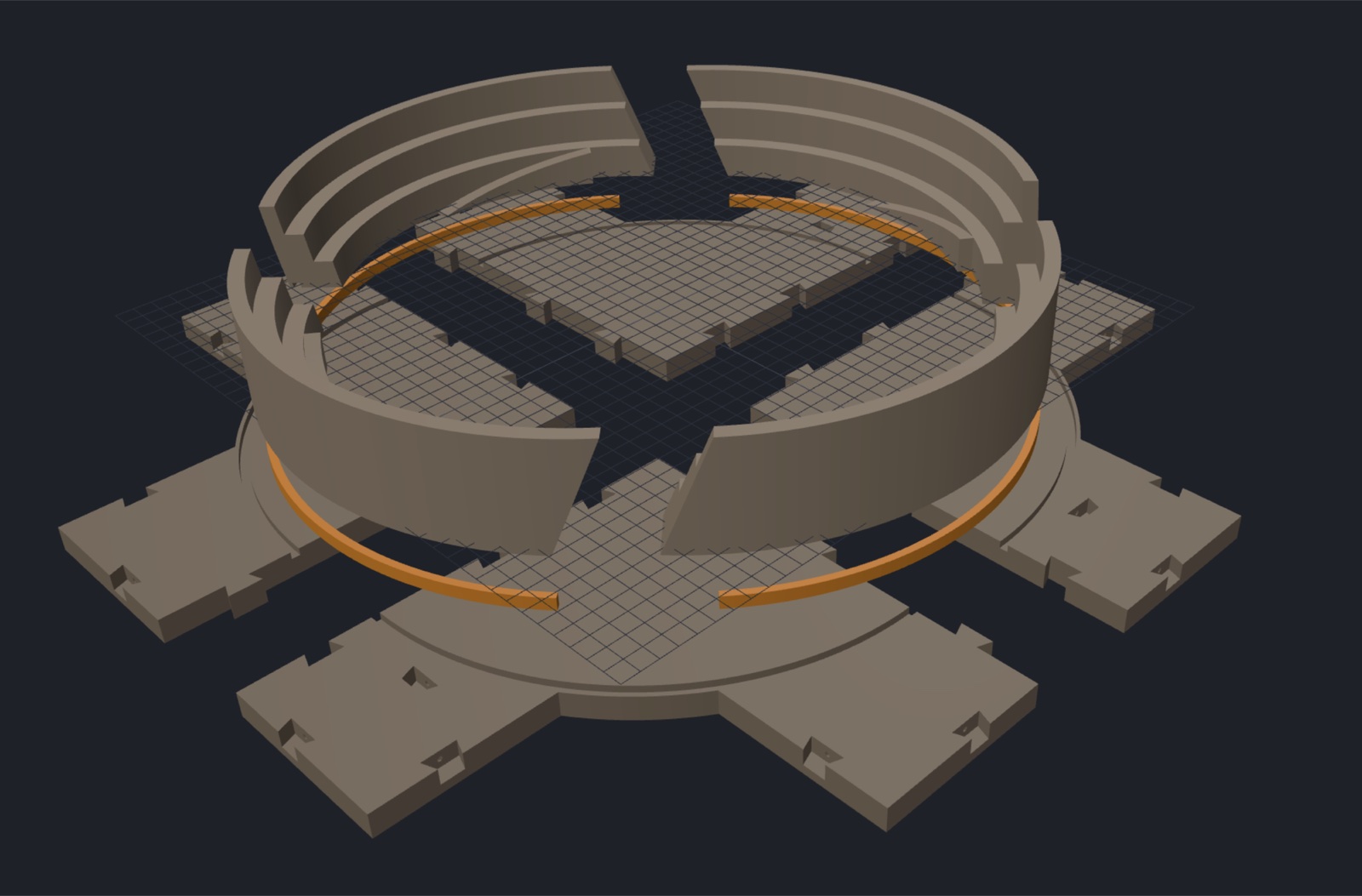
- The lentils slide out through the outlet, over a short spout, into a notch cut into the top of the crater's rim, and drop onto the first bench, back in the pit.
- The grate lifts out by a finger loop, and the gems tip into a cup for counting.
- A braced stand holds the bin up. One foot clicks into the board's existing socket.
The chute that was in the way
My sketch had a chute out into the pit, and the first model did that: a trough reaching 45 mm past the rim. Then Claude checked it against the real arm. It posed the arm through every digging position at each swing angle and checked for collisions. From about 20° toward the hopper, most digging poses hit the chute, and from 30° every one did, for both my arm and my neighbour's.
So the chute became a spillway: a notch in the rim's top, with nothing standing inside the rim. Each crew's hopper sits at the middle of a rim segment, so all four segments still print from one file, now with the notch.
The bin's wall still sits close to where the arms dig the edge of the pit. Each arm digs freely to about 25° on the hopper's side, out of the pit's 43°. Beyond that, the collision guard will stop it short of the bin. Moving the bin 20 mm further out would win back about 8°, but I've left it where it is for now.
A scoop, not a spoon
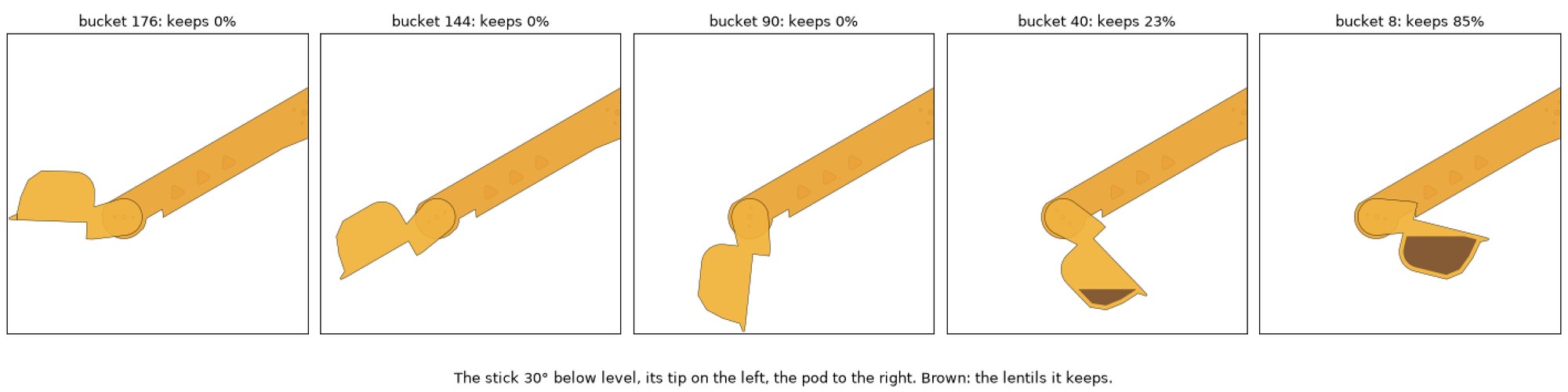
With the hopper in place I looked at the bucket again. It didn't curl up enough: the bucket opened along the stick, like a cup on the end of it, so curling turned the opening into the stick. Claude worked out how much each bucket angle would hold. It only kept its load with the stick within about 30° of straight down, and spilled on the way to the hopper.
Claude's first fix was a bucket that opened the other way and carried with the stick level. It worked on paper, but it was upside down: it scooped like a spoon. A digger's bucket is a scoop. It bites toward the machine and curls closed under the stick.
So the bucket is now a scoop, its bowl on the underside. It folds 140° under the stick and stays almost full with the stick 30° to 50° below level, which is just where the arm can lift it over the hopper. There, opening it dumps the load, the way a real excavator loads a truck. The SG90 only turns 180°, so its horn is re-timed: closed at 0, in line with the stick at 144, open at 180.
Next
- Print two cheap tests: a square of the grate (do lentils fall through and gems stay?), and a 32° plate (do dry lentils slide on PLA?)
- Add the notch to Game Board 1's rim
- Add the bin to both arms' collision guards
- Reprint the bucket, flash the firmware, and re-fit the bucket's horn in line with the stick (144)
What I learned
- A sketch on a sticky note is a fine spec. The bin, the grate and the way back to the pit were all on it.
- Check against the real arm, not a flat drawing. Seen from above, the chute looked out of the way. Moving the actual arm through its digging poses showed it wasn't.
- Keep the pit clear. Anything standing inside the rim gets in the way of the digging.
- Draw the motion with the load in it. A drawing of the bucket at five angles, with the lentils it keeps, settled in a minute what two rounds of numbers hadn't.
Comments (0)